Common Pain Points to Print PETG Filament

Bambu petg printing is hindered by 4-5 key challenges that stem from its material properties (slight flexibility, moisture absorption, and temperature sensitivity), feed path friction, and slicer setting mismatches. These issues—warping/poor adhesion, stringing/oozing, weak layer bonding, nozzle sticking, and filament breakage—lead to wasted material, failed prints, and inconsistent results, especially in bambu ams petg setups with longer feed paths.

Bambu PETG Warping & Bed Adhesion Failure

Bambu PETG frequently warps at the edges or lifts from the print bed, especially in low-humidity or unheated environments. Its slight flexibility and shrinkage during cooling disrupt the bond with the bed, causing unstable base layers, layer separation, and complete print failures—compounding when using unoptimized bed temperatures or insufficient surface preparation.

Bambu Lab PETG Stringing & Oozing

Bambu Lab PETG is prone to stringing (thin plastic strands between printed parts) and oozing (uncontrolled filament flow during retractions). These issues leave rough, unprofessional surface finishes, require time-consuming post-processing, and waste filament—often triggered by moisture, suboptimal retraction settings, or overheating.

Bambu PETG Weak Layer Adhesion

Poor layer bonding is a common frustration with bambu petg, resulting in brittle prints that break easily along layer lines. This stems from incorrect nozzle temperature (too low to fuse layers)、inconsistent extrusion、or excessive cooling during printing—critical for functional parts that require structural integrity.

How to Use the Bambu PETG Filament Printing Solution

  • Step 1

    Dry Bambu PETG Filament Thoroughly

    The primary solution for bambu petg stringing and balling is eliminating moisture—moisture causes steam pockets in molten PETG, leading to uneven extrusion, oozing, and plastic clumping (balling) on the nozzle.​

    Dry properly:

    Use Bambu Lab’s official dryer or third-party options at 40–60°C (104–140°F) for 4–8 hours (extend to 8–12 hours if the spool was opened for more than 24 hours).​

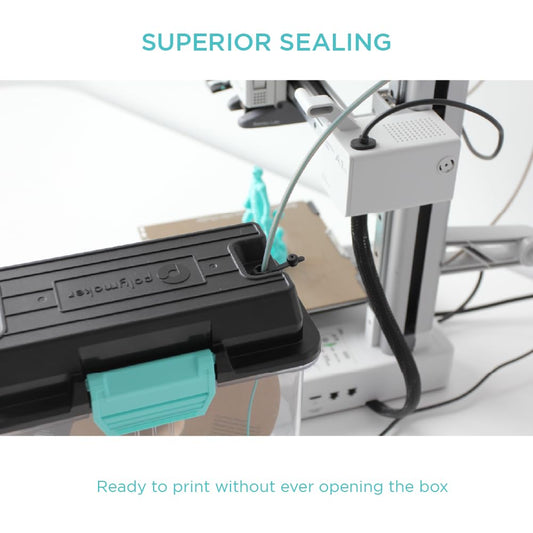
    Print with sealed storage:

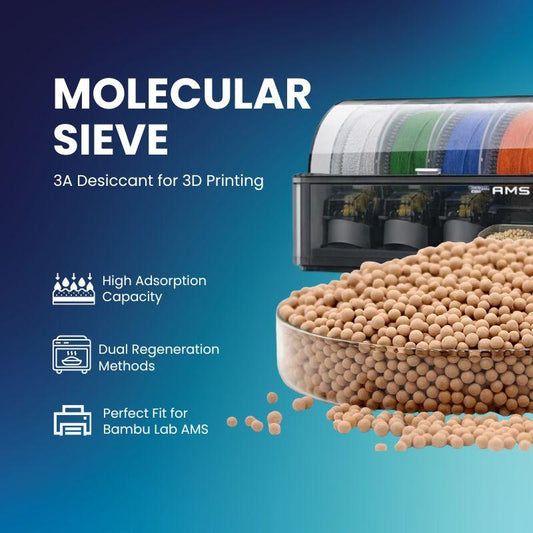
    Keep filament in a dry box with molecular sieve desiccants during printing (dry-while-printing is recommended to prevent reabsorption).​

    High-humidity protection:

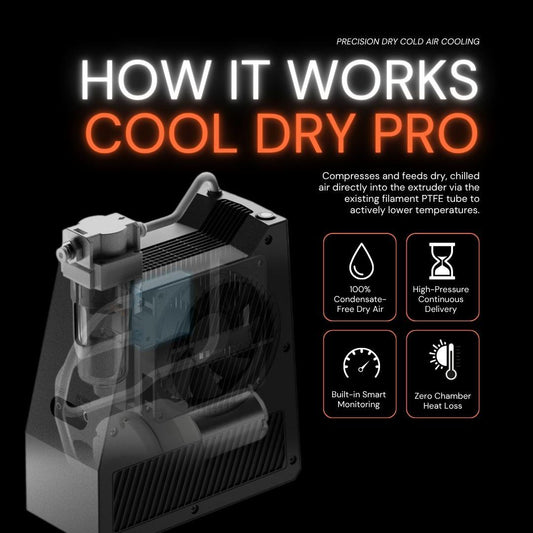
    Use Colddry to maintain dry feed paths and prevent moisture from entering the PTFE tube—critical for avoiding balling mid-print.​

    Long-term storage:

    Vacuum-seal unused BambuLab PETG with desiccants to preserve dryness and prevent brittleness.

  • Step 2

    Optimize Chamber & Bed Temperature (Fix Warping)

    Warping in bambu petg is directly addressed by maintaining consistent, warm temperatures:​

    Chamber temperature control:

    Keep the printer chamber at 40°C (104°F) (use a partial enclosure or Bambu Lab’s built-in chamber heating if available) to minimize temperature fluctuations that cause shrinkage and lifting.​

    Bed temperature:

    Set the heated bed to 60–70°C (140–158°F) (adjust to 65–70°C (149–158°F) for larger prints) to ensure strong initial adhesion and prevent edge warping.​

    Preheat stabilization:

    Let the bed and chamber reach target temperatures and stabilize for 10–15 minutes before starting the print—avoids cold spots that trigger warping.​

    Draft protection:

    Even with chamber heating, block external drafts (e.g., near windows or fans) to maintain consistent 40°C (104°F) chamber temperature.

  • Step 3

    Increase Extrusion Temperature + Cool (Boost Layer Adhesion)

    To achieve strong layer bonding in bambu petg, increase the nozzle temperature to 280°C (536°F) (critical for full filament fusion)—but counteract the risk of balling/stringing with cooling or speed adjustments:​

    Set nozzle temperature:

    Adjust to 280°C (536°F) (start at 270°C (518°F) for sensitive PETG blends, then increment to 280°C (536°F) for maximum layer adhesion).​

    Prevent balling at high temps:

    Choose one of two solutions:​

    • Option 1: Install an extruder air conditioner (e.g., Bambu Lab’s specialized cooling accessory) to lower the nozzle’s ambient temperature and prevent molten PETG from clumping.​
    • Option 2: Reduce print speed to 30–40mm/s (0.98–1.31in/s) (slower extrusion gives PETG time to cool slightly before the next layer, avoiding balling while maintaining layer fusion).

    Layer height

    Use 0.15–0.2mm (0.006–0.008in) layer height to increase contact between layers—enhances bonding when paired with 280°C (536°F) extrusion temperature.

Print Results: Before & After

See the dramatic improvement after applying our recommended settings and upgrades for Bambu Lab printers.

Part Warping without Chamber Heater
Part With No Warping Using Our Heater Upgrade

7 products

Sort By

Best selling
  • Sort By

FAQs about Bambu PETG Filament Printing Solution

Why are both an extruder cooler and heat chamber necessary for PETG printing?

PETG’s printing difficulty lies in balancing temperature:​
Extruder cooler is necessary: To achieve strong layer adhesion, PETG requires high nozzle temperatures (270–280°C / 518–536°F). However, insufficient heat dissipation at the hotend causes the filament to soften or melt prematurely in the feed tube, leading to clogs. CooldryPro directly targets the hotend area—preventing overheating while maintaining the high nozzle temp needed for layer fusion.​

Without consistent chamber temperature, drafts (from cooling fans, open doors, or room airflow) cause rapid temperature fluctuations. This triggers PETG’s shrinkage, leading to warping or edge lifting. While LAC glue can temporarily fix adhesion, it doesn’t resolve the core issue of uneven cooling—resulting in cracked middle layers. Chamber heating stabilizes the print environment, eliminating shrinkage-driven warping and layer separation.​
Together, they address PETG’s dual needs: high nozzle temp for bonding and controlled cooling/environment for structural stability.

Can I use 280°C (536°F) for all 3rd Brand Bambu PETG variants?

Most standard bambu petg blends tolerate 280°C (536°F), but check the manufacturer’s recommendations for specialty variants (e.g., reinforced or colored PETG). If the filament degrades (smoke or strong odor), lower to 270–275°C (518–527°F) and compensate with slower print speed (30mm/s / 0.98in/s) to maintain layer adhesion.

Will this solution work with other Bambu Lab printer models?

Please refer to the filter menu on the left sidebar to verify supported models. For inquiries about other machines, contact us at support@call-3d.com for further confirmation.

Is there a detailed video for setting up these solutions?

Yes. Follow our Call3D YouTube channel, search for the setup video, and bookmark it.

Expert Testimonial

  • I’ve known Enderwick since 2014 and worked alongside him for many years. With over a decade in the industry, he and his team bring an extremely high level of expertise.He has built an enormous 3D printing community here in China and is always coming out with new solutions—each one never fails to impress me.
    3D printing Editor Daniel O‘Connor
    Daniel O'Connor
    Deputy Vice President of TCT Magazine
  • When EP invited me to Shenzhen back in 2019, I was absolutely blown away by the hardware innovation coming out of China. Just one year later, Bambu Lab burst onto the scene—and their solutions have grown right alongside Bambu, evolving from the very beginning to where they are today.
    3D printing Expert Chris Connery
    Chris Connery
    VP for Global Analysis at CONTEXT